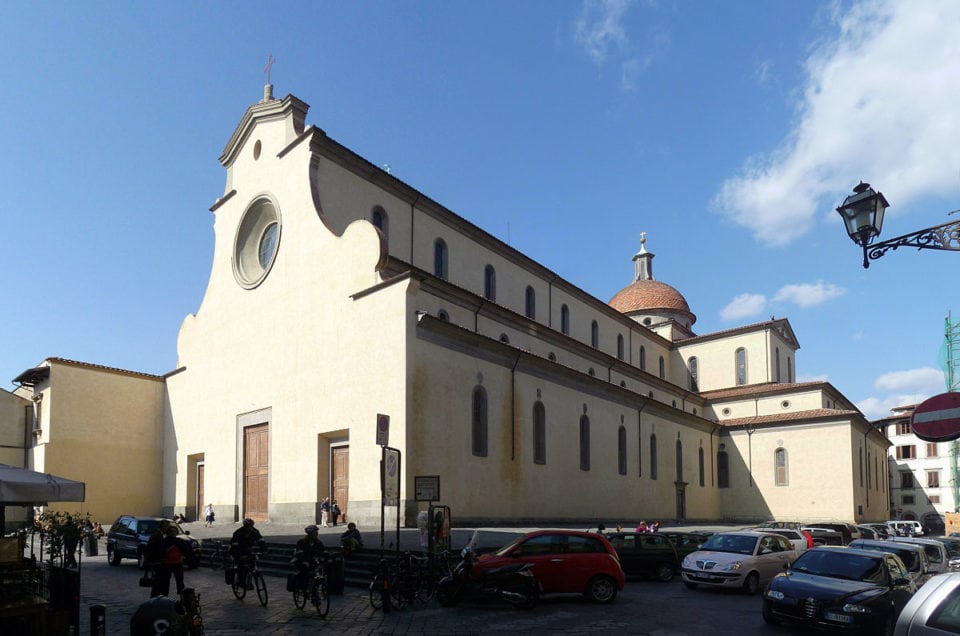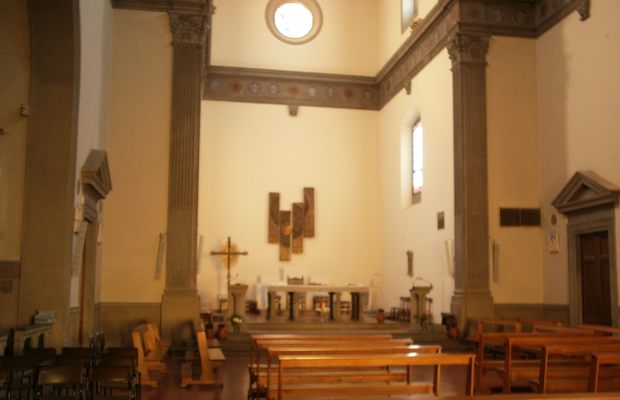
The luminous interior of this beautiful Dominican church is defined by the spacious high altar whose grandiose window is decorated with splendid stained glass from the end of the 15th century.
As you go in, on the left hand wall, you will see a superb fresco painted around 1426 by Masaccio, depicting the Trinity adored by Mary and St John, and adored also by the two purchasers who are shown outside the architectonic stage setting. This work has recently been restored and has got back its beautiful colors, making it even more qualified to be termed a Renaissance masterpiece, above all because of the geometric perfection of its perspective, the vigorously modelled and expressed figures, and the classical references in the architecture.
Below the main subject of the painting, you can see a skeleton, a warning to lead a life according to God's commandments. The skeleton is overlooked by an inscription which reads: "io fu già quel che voi sete, quel ch'io son ancora voi sarete" –significant words, meaning "I was what you are now, and what I am now you shall be".
Together with this extraordinary fresco by Masaccio, the large crucifixion panel painted by Giotto was also restored. It dates from the beginning of the 13th century and is noteworthy because of the vigor of the tormented Christ and the moving expression of sorrow you can see on the faces of Mary and St John.
This work is a powerful reminder of how mature Giotto was as an artist, and of his very delicate mastery of color.